
Objects and Commodities
Are we talking about surplus yet?

A household object is a part of a daily routine in a family. Objects hold meaning as part of structure, of a lifestyle or the habitus1. It is our ways of living in the world, our dispositions, the house we belong to along with the paraphernalia, our people, loosely describes it. And objects demand a certain care as they become a part of a habitus. We interact with objects and make them ours.
They may convey affirmations of faith and circulate meaning through rituals. They manage the burden of value for a migrant, into another landscape of aspirations calling for glorifying the objects or discarding them in order to organize and present a new way of life.
Value is embedded in objects through rituals of symbolic and emotional work. A new item is important to us but it gathers more value while in use and stays valuable, until something changes in the habitus.
Items like this lota below and others were of high value in the economy back then in India where the research is situated. It was an economy that did not gather much surplus. Or what was gathered by the economy was put back into the infrastructure development, of a country, or of a home. At a personal level, this was the case because incomes were limited and surplus was not heard of, a disposable income was anathema.
What else is part of this story of this object? What went into the making of these things and why are they valuable to a family?
What is the value of similar items now in the present day and where is this value residing? Is it in the making of the products or marketing of the brand? Does an object turn into a commodity in the marketplace? Is the value in this journey of the items? Is it in the killing fields of demand that usurps value and brings in the delightful images that we consume? From the making of the most basic product on an assembly line, to its sale, we see the value inflating and emptying itself into the object. It becomes a commodity when the value is added to it for purchase, including symbolic value.
My research on consumption started back in 1997, the light being lit in 1989 with new reaches and access to global capital brought into the Indian economy. What has this disposable income or the surplus, done to our lifestyles in a short span of time? How has the last several years changed things? The idea is not to explore the breadth, width and depth of consumption in the society but to give some nudges into thinking about consumption in this way to enable some new thoughts and understandings.
The usurpation and creation of new meanings via global capital is here to stay. It has its own form and nature. What does it do to our lives today? Where is it located now and where was it back in the day?
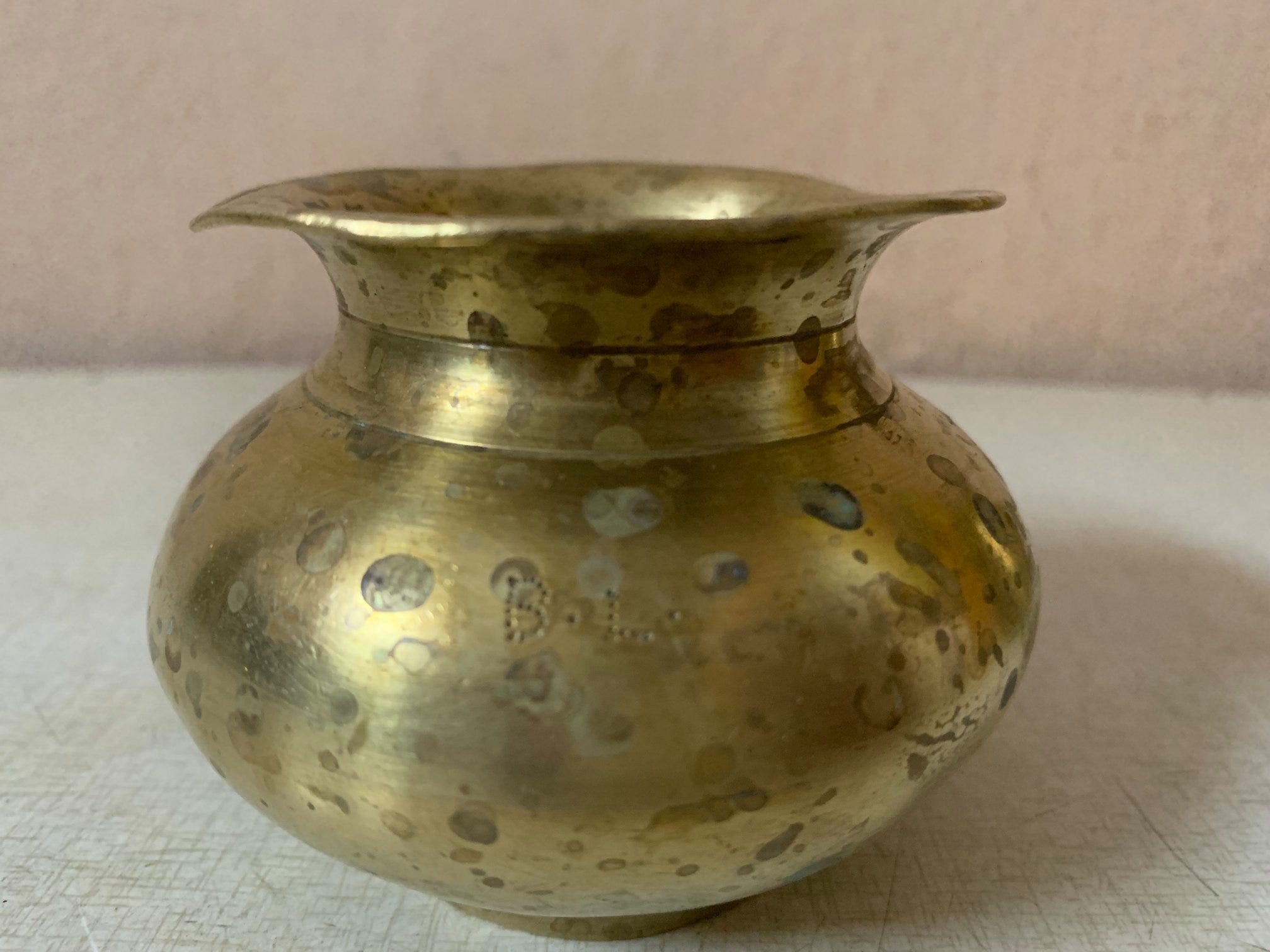
Interesting questions stay in the story as to who the merchants were that sold these objects or where they might be now? Who among the brass and steel merchants had the first ability to write manually on metal and then use the small, machine gun like pen attached to a wire that allowed for the writing on the metal? What brought this about as a cultural marker of ownership of household objects that even to this day has great significance in India?
In my research on Micro History in Hyderabad, the community has shared stories about the family memorabilia, the famous paraath among things of value, antiques, vintage items, papers/documents with a story - in other words, cultural objects. This research is a dashboard to collect stories about items of significance to individuals and families, stories of value. Also of value are the stories of the diaspora that have moved far flung into the world, locating themselves into a time and place, more often than not, retaining the Brahma Kshatriya culture.
This object here is a lota, a brass vessel used as kalash in pujas. The ritual meaning of kalash and the significance of the water held inside is paramount in a puja and is available to understand, as we know it. It is used to bathe the gods, calling forth the rivers of Ganga, Yamuna, Saraswathi (or is it Cauvery/Godavari?), for the ablutions, to begin a puja, then anointing the god with the sandalwood paste, the kumkum and rice, each signifying more than just the physical item and in the process finding ways to focus on and reminisce a higher presence.
The letters on this brass lota are marked B. L. and they stand for Bidri Lal. This lota is the provenance of the Waghray family from Kachiguda, Hyderabad.
The lota travelled to the US with me and came back to be a part of this archival research2. While in the US it was a part of my dual-cultural living between the US and India and a remained in my puja as well. It has a special place in this research work hence.
Here is some history about Bidri Lal from the archives written by Amolak Ram and then Govind Lal.
Bidri Lal had his early education in Mufeed-ul-Anam School and City College and B.A. from Osmania University. He was married to Shama Bai, daughter of Gajanand Pershad Shah.
His grandfather Narayan Das, alias Bachhu Lal, a Mansabdar was employed in Sarf-e-Khas and posted in the Peshi of Nizam the 6th, Nawab Mir Mahboob Ali Khan, who had succeeded to the throne in 1869. Narayan Das was one of the members of the Brahma Kshatriya community associated with who started Mufeed-ul-Anam School. He was the cousin of Bansi Lal and was honorary treasurer of the school from 1880 to 1889. Bidri Lal was the son of Navratan Lal and great-grandson of Keshav Das Waghray who migrated from Khanbad, Gujrat.
Objects tell us a story and in turn we find in it the story of the times.
A commodity is a useful or valuable thing, such as coffee, vase, water or time. We are careful about not only how we use it but also how we purchase it. Sometimes, it is already owned by us and sometimes we work in order to acquire it. In any instance, a commodity is a thing we value, bought with money. We live in a world of commodities and we are born into it or have access even before we were born. This aspect of being born into, is culture, and it helps us navigate our lives in a meaningful manner. It is created or developed but also already present around us.
Commodities can be tangible and intangible - concrete things with a physical presence and sometimes, they are available as an idea that we own or aspire for. It is through the market that we understand commodities and markets are available in the store around the corner, the facebook marketplace or amazon.
Markets are also inside of us as we measure up the value of items and ideas. As to the facility and ease of the measuring is debatable, but it is nevertheless available to measure up and down the value of an object in our lives.
Pierre Bourdieu’s seminal work Distinctions is one of the main underpinnings in this work on Consumption.
Follow https://www.facebook.com/bkcAtHyd for details.